
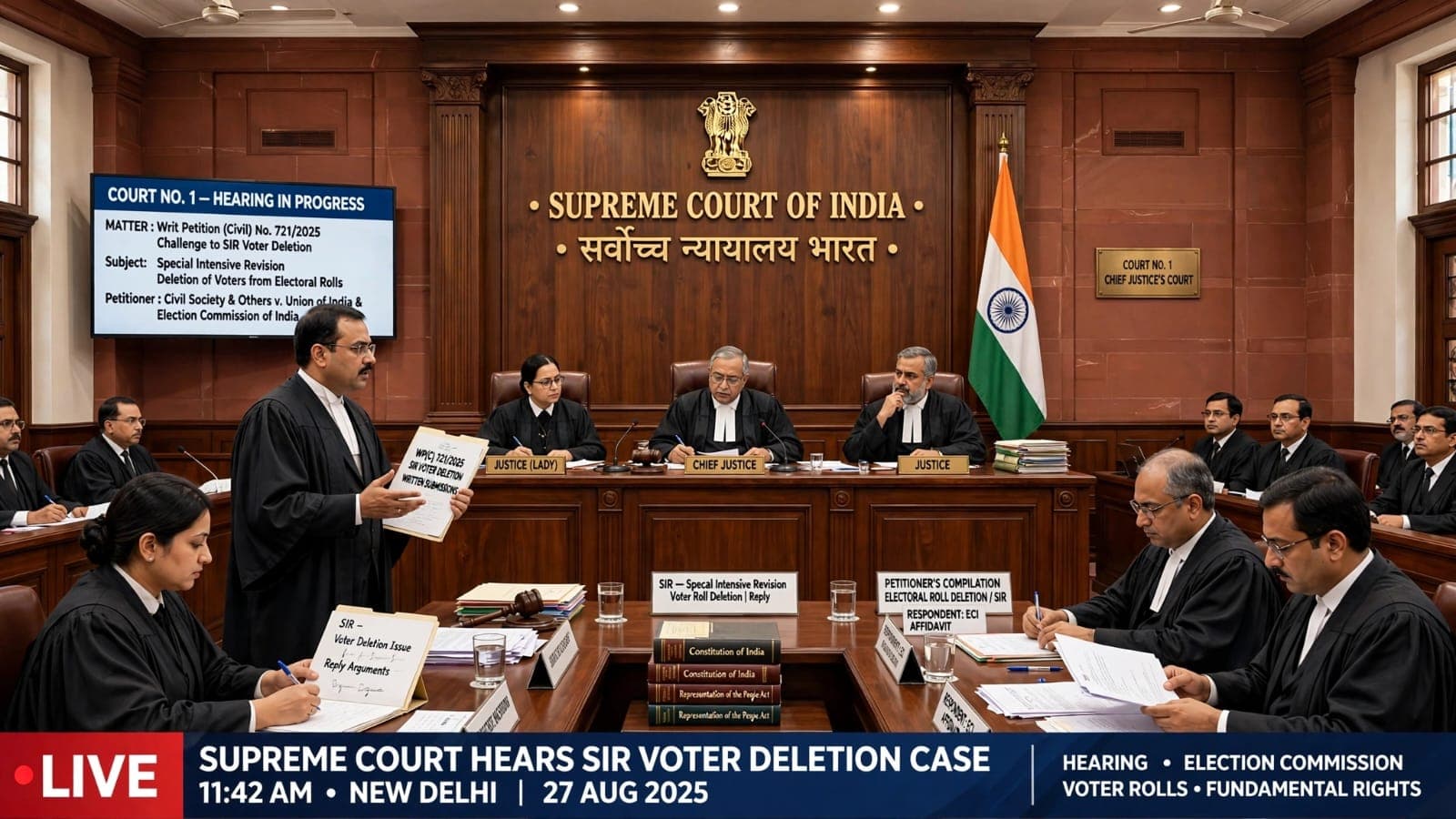
Supreme Court Hears SIR Voter Deletion Case: Election Commission, Voter Rolls Hearing
Supreme Court me SIR voter deletion case ki sunvai. Election Commission, voter rolls aur fundamental rights par Court No.1 me kya hua, poori jankari.
By Editorial Desk
Supreme Court to Hear Plea Against SIR and CEC - Understanding the 13 Crore Voter Deletion Controversy
India's electoral democracy is entering a critical phase as the Supreme Court of India is scheduled to hear on October 15, 2026, a joint petition filed by Leader of Opposition in Lok Sabha Rahul Gandhi and several other opposition leaders. The petition challenges the Special Intensive Revision (SIR) of electoral rolls and seeks full and complete disclosure of files, agendas, minutes, notings and objections recorded by Election Commissioners Sukhbir Singh Sandhu and Vivek Joshi.
The petition claims that the SIR exercise has resulted in deletion of approximately 13 crore voters across the country. This number has become politically explosive. For context, 13 crore is almost 14 percent of India's total electorate of around 95 crore. If true, it would be the largest ever deletion exercise in Indian electoral history.
The Special Intensive Revision is not new. The Election Commission has been conducting revisions since 1951. There are two types - Summary Revision which is done every year and Intensive Revision which is done after several years with door-to-door verification. The Commission says SIR was needed because over the last 10 years, many voters have shifted due to migration, urbanization and also there are duplicate entries because of Aadhaar-EPIC linkage issues and deaths not recorded.
According to the ECI's standard procedure, Booth Level Officers (BLOs) visit each house, verify voters, issue notices in case of proposed deletion and give time for objections. The ECI claims it followed this process. It has also launched digital tools like Voter Helpline App and voters.eci.gov.in to allow citizens to check their names.
However, the petitioners argue that procedure was not followed on ground. They cite examples from Bihar, Uttar Pradesh, Maharashtra and West Bengal where BLOs allegedly deleted names en masse without proper verification. They allege that many deletions belong to Dalit, tribal, Muslim and migrant labour communities who are often not at home during BLO visits. Young voters who turned 18 recently also complain that their names were not added.
Chief Election Commissioner Gyanesh Kumar is at the center of controversy. The petition asks for his internal communications and also questions why the dissent notes, if any, of other Election Commissioners were not recorded. The Supreme Court has earlier in cases like TN Seshan vs Union of India held that CEC does not have overriding powers and must act collegially.
For the last five days, Delhi has witnessed continuous protests against SIR. On October 14, hundreds were detained near India Gate and Kartavya Path as they tried to march to ECI headquarters. Police used barricades and detention buses. The protesters include civil society groups, student groups and opposition workers. They demand door-to-door re-verification.
Legally, this case tests the balance between Article 324 which gives ECI autonomy and Article 32 which gives citizens right to judicial review. The Supreme Court in 2023 in Anoop Baranwal case had ordered appointment of Election Commissioners through a panel including CJI. Now this case will test transparency in ECI functioning.
For Advancing India, free and fair elections are non-negotiable. India is world's largest democracy and its credibility depends on inclusive voter lists. If genuine voters are deleted, it weakens democracy. If fake voters remain, it also weakens democracy. Technology can help - AI-based deduplication, linking death registers with voter rolls, using postal department data for shifted voters and allowing online claims with Aadhaar eKYC can reduce errors.
The immediate impact for common man is practical. With state elections coming in 2027 in Uttar Pradesh, Gujarat and other states, voters must check their names now. The ECI has extended last date for claims and objections till October 30. BLOs are available in each polling booth on weekends.
Today's hearing is unlikely to give final judgement but Supreme Court may order disclosure of files and possibly appoint an amicus or a retired Supreme Court judge to audit random samples of deletions in 10 districts. The court's direction will set precedent for how voter roll management will be done in digital India era where 90 crore Indians have internet.
Whatever outcome, this case reminds us that voting is not just a right but foundation of Advancing India. Every vote matters and ensuring every eligible citizen is on roll is duty of both ECI and citizens.