
Energy Crisis 2026: World Failed, India Survived with 7.6% GDP Growth
Global energy crisis 2026 me jab duniya bhar me oil crisis fail hua, India kaise bacha? 7.6% GDP growth ke peeche ki strategy samjhein.
By Editorial Desk
How India Survived The 2026 Energy Crisis When Whole World Failed - The Masterstroke That Saved 1.4 Billion Indians
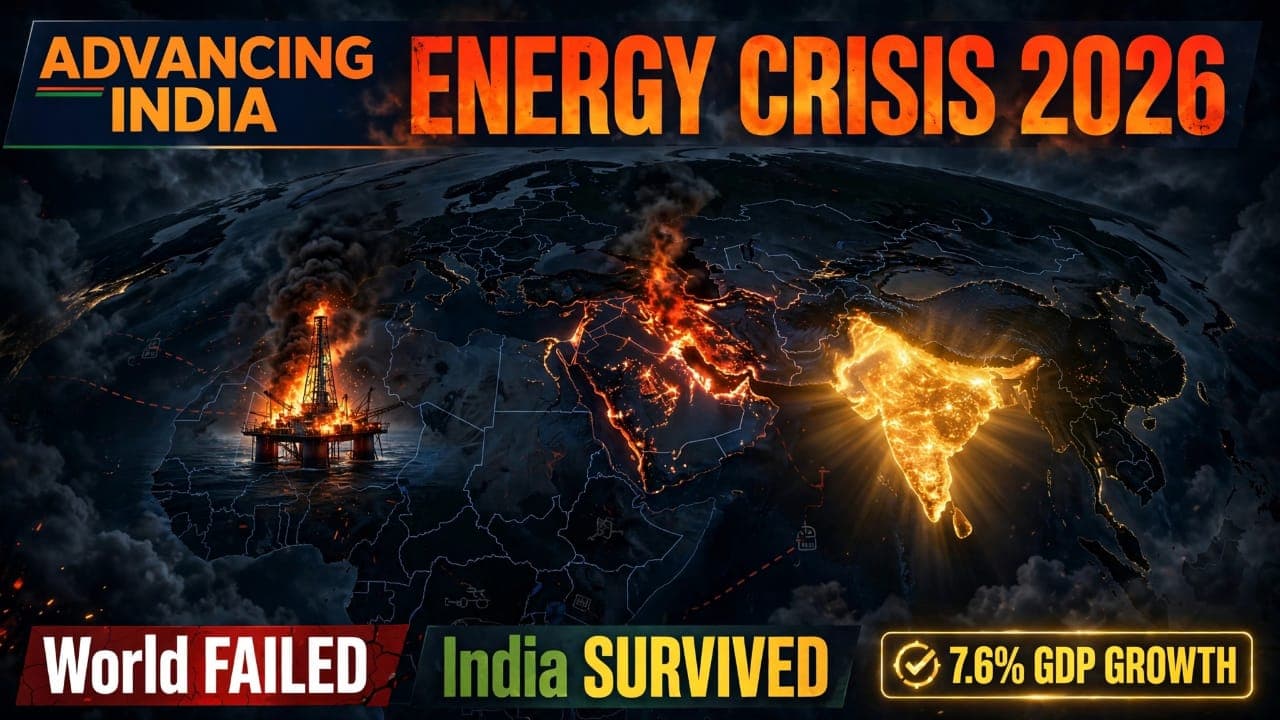
In February 2026, the world woke up to a nightmare. The Strait of Hormuz, a narrow waterway between Iran and Oman through which 25 percent of the world's oil and 30 percent of the world's gas passes, was suddenly blocked due to a major conflict between Iran and Israel. Oil tankers could not pass. Within 48 hours, global oil prices exploded from 82 dollars per barrel to 152 dollars per barrel. It was the worst energy crisis since 1973. The whole world went into panic mode. But in the middle of this global panic, one country remained calm and stable - India. While America, Europe, Pakistan, and Sri Lanka suffered from high inflation and blackouts, India's economy grew at 7.6 percent, the fastest among all major economies. How did India survive when everyone else failed?
This was not luck, this was a masterstroke that was planned 10 years ago by Prime Minister Narendra Modi. When Modi became Prime Minister in 2014, he understood that India's biggest weakness is energy. India imports 85 percent of its crude oil and 50 percent of its natural gas. If oil prices go up, India's entire economy, from farmers to factories, will suffer. So he made a four-pillar energy security plan that saved India in 2026.
The first pillar was diversification of oil sources. Earlier, India used to buy 70 percent of its oil from the Middle East. Modi's government changed this strategy. India started buying oil from many different countries - from Russia, from America, from Brazil, from Guyana, from Canada, and from Africa. By 2026, India's dependence on the Middle East had come down to just 45 percent. So when the Strait of Hormuz was blocked, India was already buying 40 percent of its oil from Russia through safe routes. Russia was giving India oil at a discount of 20 to 25 dollars per barrel because of Western sanctions, and India was happy to buy it.
The second pillar was building a massive strategic petroleum reserve. India built huge underground oil storage facilities in Mangalore, Padur, and Visakhapatnam that can store more than 90 days of oil supply. When the crisis happened, India immediately released oil from these reserves to its refineries, which kept the supply stable. The Indian government also controlled petrol and diesel prices and increased them by only 2 rupees, while in America petrol prices doubled and in Pakistan petrol disappeared from pumps.
The third pillar was massive investment in renewable energy. In the last 10 years, India has become the third largest producer of renewable energy in the world. India now has more than 210 GW of solar and wind energy capacity. Huge solar parks in Rajasthan, Gujarat, and Ladakh, and wind farms in Tamil Nadu and Gujarat, produce cheap electricity. During the oil crisis, India shifted many industries and railways to use electric power instead of diesel. Indian Railways, which is now almost 100 percent electrified, saved thousands of crores of rupees.
The fourth pillar was financial stability through UPI and digital economy. Because India has a strong domestic digital payment system, money kept circulating in the economy. People kept buying and selling, farmers kept getting payments, and small businesses kept running. While other countries faced cash crunch and economic slowdown, India's domestic consumption, which is 60 percent of GDP, kept the economy growing.
The world was shocked to see India's performance. The IMF had predicted that India's growth would fall to 4 percent during the crisis, but India grew at 7.6 percent. Inflation in India was only 4.5 percent, while in Europe it was 9 percent and in America it was 7 percent. Foreign investors saw India as the only stable country and started investing more money in India. Many factories that were in China started moving to India because India had stable and cheap energy.
Jaishankar's foreign policy also helped. He had already told the world that India will buy oil from wherever it is cheapest to protect its 1.4 billion people. When the crisis came, India did not face any pressure to stop buying Russian oil, because India had already made its position clear. Europe, which had criticized India earlier, was now secretly buying Indian-refined diesel made from Russian oil.
This energy crisis was a proud moment. The India that used to have 10-hour power cuts in villages in 2012 now has 24-hour electricity even during a global crisis. The India that used to beg for oil now manages global oil markets. This is the difference between old India and New India. New India plans for 10 years ahead, New India thinks about 1.4 billion people first, and New India never bows down to any pressure. This is why the world now sees India as a leader who can show the way when the whole world fails. This is the rise of India as a true superpower.