
India US Trade Growth +11%: Bilateral Trade, Exports Up 2024-2025 Explained
India aur US ke beech trade me 11% ki growth. 2024-2025 me exports badhe, cargo volume aur bilateral partnership ka poora analysis janein.
By Editorial Desk
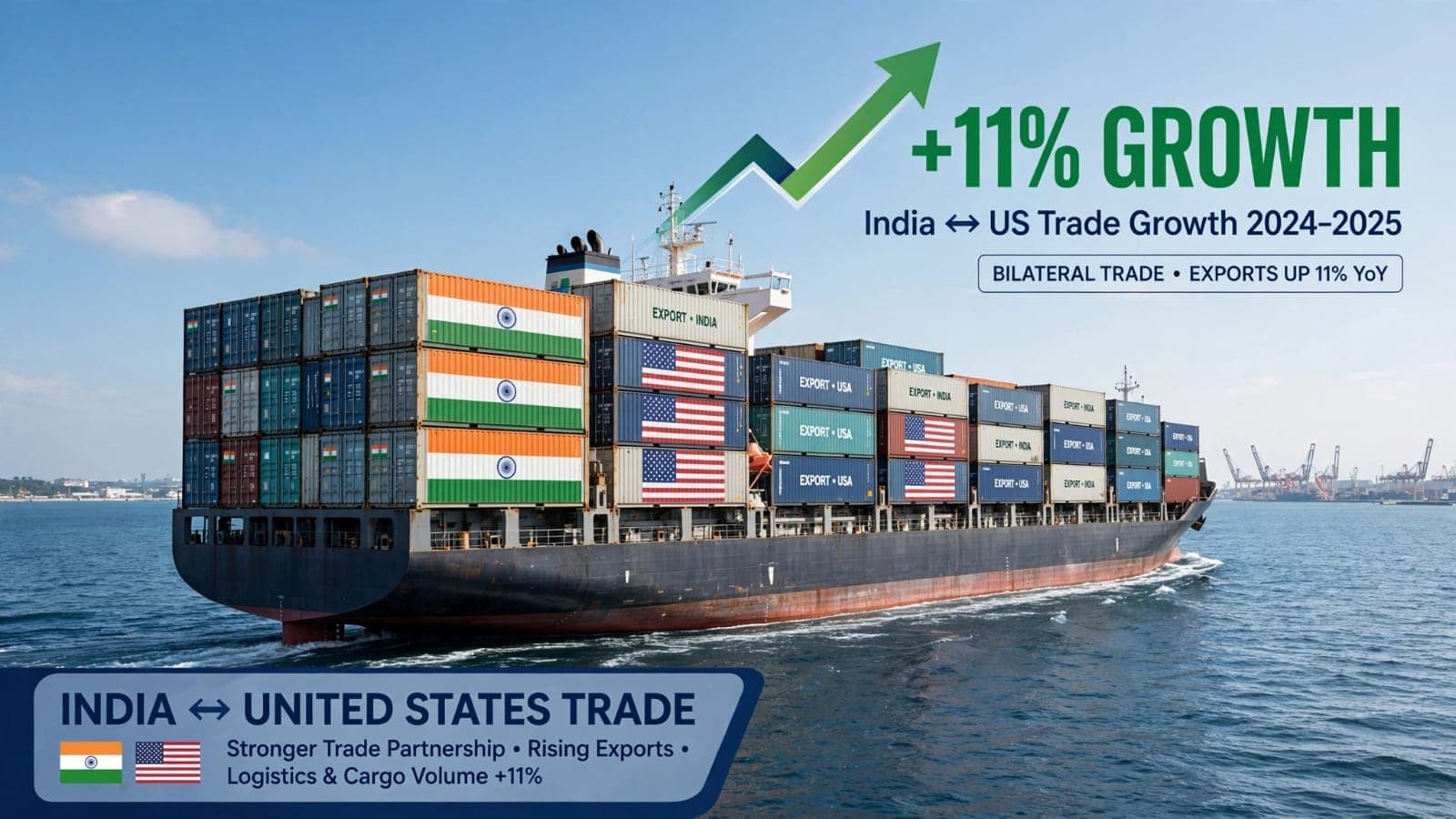
India's Exports to US Grow 11.1 Percent to $50.81 Billion - Trade Surplus Narrows as Interim Deal Nears
India's merchandise exports to United States, its largest export market, grew by 11.1 percent year on year to $50.81 billion during April-September 2026, while imports from US grew faster at 26 percent to $25.82 billion, resulting in trade surplus of $24.99 billion versus $26.06 billion last year, according to Commerce Ministry data released October 15, 2026.
This data comes amid global trade slowdown. WTO projects world trade growth only 1.7 percent in 2026 due to Red Sea crisis, US-China tariff war, EU stagnation. In that context, double-digit growth to US is strong performance.
What is driving export growth? Electronics - India exported smartphones worth $9.8 billion to US in six months, up 45 percent, led by Apple iPhone made in Tamil Nadu and Karnataka under PLI scheme. Apple now makes 14 percent of global iPhones in India. Samsung also exports from Noida. Engineering goods - $12.5 billion, up 12 percent, includes auto components from Pune, Chennai supplied to Tesla, Ford, industrial machinery. Pharmaceuticals - $5.2 billion, up 8 percent, India supplies 40 percent of generic drugs in US. Textiles and apparel - $6.1 billion, up 7 percent despite Bangladesh competition. Petroleum products - $4.3 billion from Reliance Jamnagar refinery.
Import growth - crude oil $8.1 billion, up 60 percent as India diversifies from Russia to US WTI crude due to sanctions and price cap issues. LNG $2.5 billion, up 40 percent. Aircraft and parts $3.2 billion including Boeing aircraft for Air India, IndiGo. High-tech machinery, especially for semiconductor fabs in Gujarat.
Trade surplus narrowing is actually healthy sign - it means India is buying more from US, reducing political friction. US has been complaining about trade deficit with India for years. Now deficit down to $25 billion from $38 billion in 2022.
Interim trade deal: Commerce Secretary confirmed negotiations are in advanced stage. Interim deal likely by December 2026. What will it include? US likely to reduce tariffs on Indian steel and aluminum from 25 percent to 10 percent under quota, restore GSP benefits for 3,500 products worth $6 billion which were removed in 2019, allow Indian mangoes, grapes, pomegranates with easier phytosanitary norms. India likely to reduce tariffs on US pecan nuts, almonds, apples, bourbon whiskey, motorcycles, reduce price controls on medical devices like stents, and agree to data flow principles for digital trade.
Full FTA is complex - US wants market access in agriculture (dairy, corn), strong IP protection, data free flow, while India wants H1B visa liberalization, totalization agreement to avoid double social security payment for Indian IT workers (costs $2 billion annually), and protection for small farmers. So interim deal first, full FTA later by 2028.
For Advancing India, US market is critical for jobs. Every $1 billion textile export creates 180,000 jobs in Tiruppur, Ludhiana. Every $1 billion iPhone export creates 25,000 assembly jobs plus supplier jobs. MSME participation in exports is 45 percent. Government schemes like RoDTEP, interest equalization, district export hubs help.
Challenges: US Inflation Reduction Act gives subsidies to US-made EVs, batteries, green hydrogen, disadvantaging Indian exports. EU CBAM carbon tax also hits steel, aluminium. India needs to respond with its own green certification and carbon market.
Also rupee-dollar: Rupee at Rs 88.5 per dollar makes exports competitive but imports costly. RBI managing volatility.
Opportunity: China Plus One - US companies want alternative to China. India with large labour, improving logistics, PLI incentives, is natural choice. Companies like Micron (semiconductors), Applied Materials, Foxconn expanding.
Small exporters: Many still struggle with US FDA, USDA standards, packaging, litigation risk. Commerce Ministry's Trade Connect portal, ECGC insurance, and Indian embassies' market intelligence help.
Outlook: If interim deal signed, bilateral goods trade could reach $200 billion by 2028 and $500 billion total trade including services by 2030. Services already $80 billion - IT services, consulting, financial services. With AI, GCCs, that will double.
Current 11.1 percent growth shows India is not just services exporter but manufacturing exporter to US, which is core of Make in India and Advancing India vision. Maintaining quality, timely delivery and compliance will be key to sustain this momentum despite global uncertainties.