
India New Zealand FTA Agreement 2026: Free Trade Deal, Tariff Benefits Explained
India aur New Zealand ke beech FTA agreement 2026. Is free trade deal se textile, pharma, dairy trade aur tariff me India ko kya fayda hoga?
By Editorial Desk
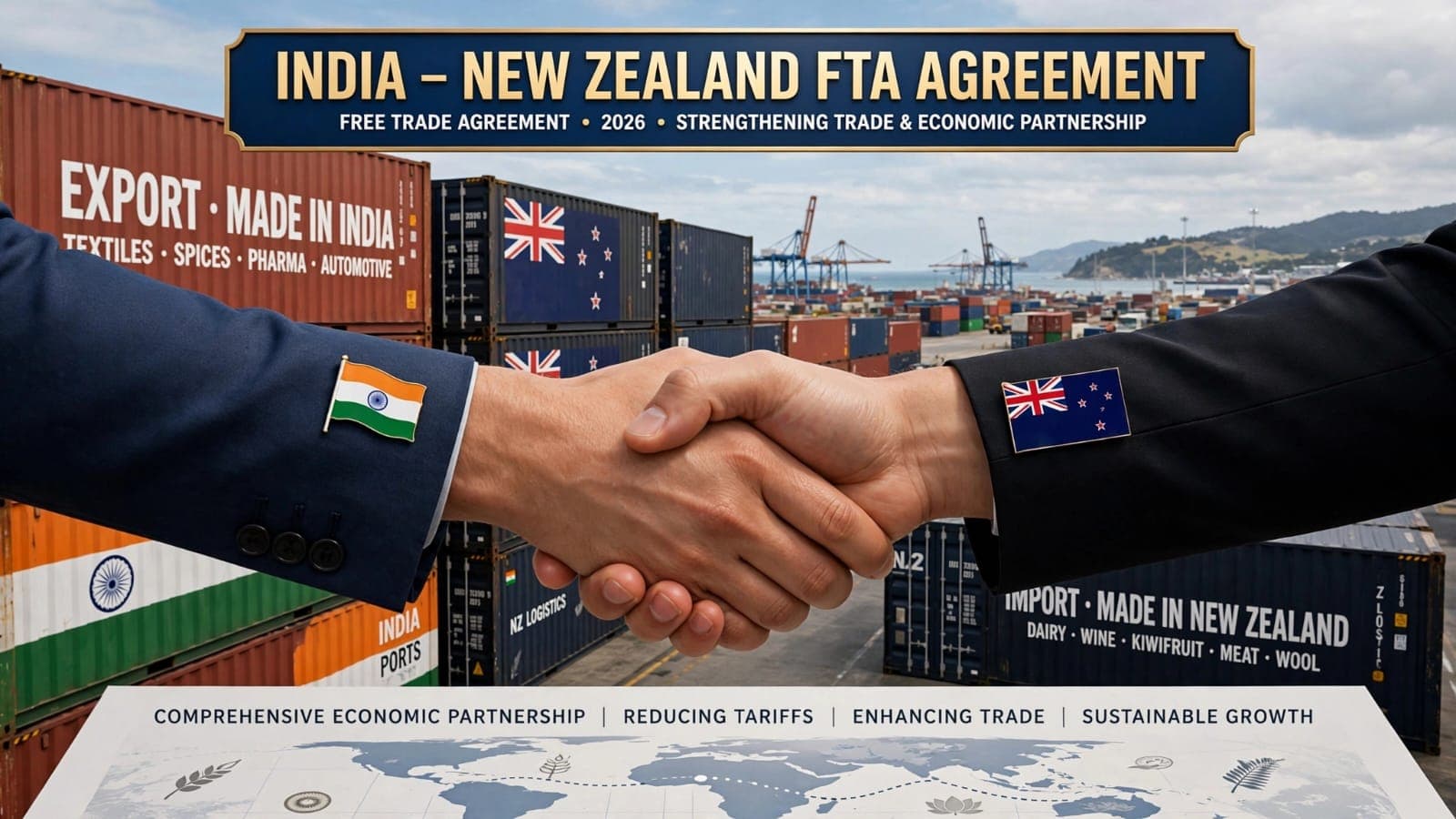
India-New Zealand FTA to Start October 20 and India-Canada CEPA by Year End - Big Push to Diversified Trade
India's Commerce Ministry announced on October 15, 2026, that India-New Zealand Free Trade Agreement will come into force from October 20, 2026, while India and Canada aim to conclude Comprehensive Economic Partnership Agreement (CEPA) by December 31, 2026. This double announcement shows India's accelerated FTA strategy amid global trade uncertainties.
India-New Zealand FTA negotiations started in 2010, paused, restarted in 2023 and concluded in early 2026. New Zealand population is only 5.2 million but GDP per capita is $48,000, making it high-value market. It is known for dairy, meat, wool, fruits, timber and education.
What India gets: Zero duty access for 95 percent of tariff lines. Key winners - textiles and apparel from Tiruppur, Ludhiana; leather footwear from Kanpur, Agra; marine products from Kochi; engineering goods, auto components from Pune, Chennai; pharmaceuticals; organic chemicals; toys; and IT services. New Zealand tariffs of 5-15 percent will become zero, making Indian products cheaper than Chinese who already have FTA.
What New Zealand gets: Access to Indian market of 1.4 billion for apples, kiwi fruit, timber, wool, wine and education services. However India protected sensitive agriculture. Dairy is most sensitive - India has 80 million dairy farmers, mostly small. New Zealand is world's largest dairy exporter and its milk powder is very cheap due to large farms. India agreed only to small quota of 10,000 tonnes of milk powder at 30 percent duty vs 60 percent MFN, with safeguards. Similarly, apples - India produces 2.5 million tonnes in Himachal, Kashmir, Uttarakhand. New Zealand apples will be allowed only in off-season April-June at reduced duty to avoid harming local harvest in Sept-Dec.
For MSMEs, FTA is opportunity. New Zealand has 90 percent internet penetration and high e-commerce use. Indian handicrafts, Ayurveda products can be sold via Amazon NZ. Government launched Trade Connect platform where exporter can check duty benefit by entering HS code.
Canada CEPA update: Fifth round held in Ottawa Oct 5-9 covering goods, services, investment, rules of origin, IPR, sustainability, digital trade. Canada is $2.2 trillion economy, G7 member. Bilateral trade $8.3 billion now but potential $15 billion. Canada wants access for pulses (India is world's largest importer of lentils, peas), potash, uranium, canola oil, aircraft parts. India wants access for textiles, pharma, IT, jewellery, auto parts and easier visas for professionals. Issues - Canada has 1.4 million Indian diaspora, but recent diplomatic tensions over Khalistan issue slowed talks. Now both sides want to separate trade from politics.
For Advancing India, FTAs are strategic tool to de-risk exports. Currently 55 percent of India's exports go to US and EU. If those markets slow or impose carbon tax (EU CBAM from 2026), India needs alternative markets. Australia FTA (2022), UAE CEPA (2022), EFTA (2024), UK (2025), NZ (2026) create web of FTAs covering 40 percent of world GDP.
Benefits beyond tariffs: FTAs include chapters on customs facilitation which reduces clearance time from 2 days to 1 day, mutual recognition of standards which means Indian pharma plant approved by USFDA will be accepted by NZ, digital trade chapter allowing paperless documentation, and investment protection.
Challenges: FTA utilization. Study shows only 25-30 percent of eligible exporters actually use FTAs because they don't know rules of origin documentation. Rules of origin require 40 percent value addition in India to claim FTA benefit to prevent Chinese goods routing via India. Small exporters find paperwork complex. Commerce Ministry now organizing 100 workshops, simplified certificate of origin via online portal.
Farmers: Some farmer unions in Punjab fear Canadian pulses import will depress local prices. Government says it will use Minimum Support Price and import monitoring to protect. Experience from Australia FTA shows pulses import actually stabilized prices, not crashed, because Indian demand exceeds supply by 3 million tonnes.
Students: Both NZ and Canada FTAs include education and mobility. 30,000 Indians in NZ, 400,000 in Canada. Easier post-study work visas expected.
If implemented well, India-NZ FTA effective Oct 20 will be small but symbolic step showing India can sign and implement high-quality FTAs with developed countries balancing exporter interests and farmer protection, a model for Advancing India as global trade player.