
5G-Enabled Ecosystem in India 2026: How Fast Internet is Powering Startups, Telemedicine and Smart Manufacturing
5G becomes backbone of India economy in 2026, powering smart factories in Pune and telemedicine in villages.
By Editorial Desk
5G-Enabled Ecosystem in India 2026: How Fast Internet is Powering Startups, Telemedicine and Smart Manufacturing
When 5G was launched in India in late 2022, many thought it was just about faster downloads for watching movies. By 2026, that perception has completely changed. 5G has become the invisible backbone of India’s new-age economy, seamlessly connecting remote and urban markets and narrowing historical infrastructure gaps. It is one of the most renowned business trends in 2026 because of its capability to power sectors that were previously unimaginable.
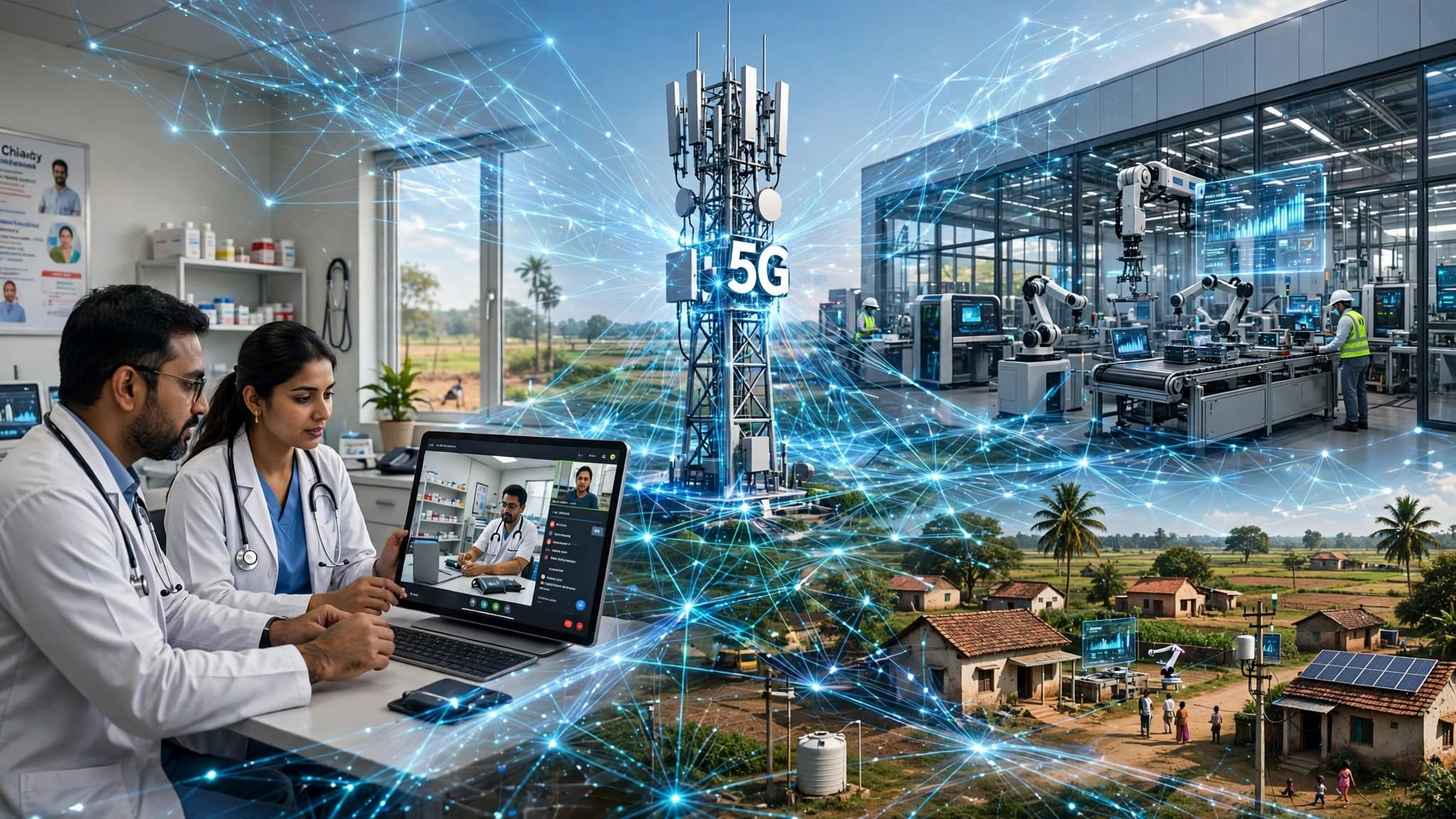
The most visible impact is in smart manufacturing. Factories in Pune, Chennai, and Manesar are now using 5G-enabled IoT sensors to monitor machines in real-time. A small defect in a car part can be detected and corrected within milliseconds, reducing waste and improving quality. This precision manufacturing is helping Indian companies compete globally. Global Capability Centres (GCCs) are expanding rapidly, with higher headcounts in engineering and data analytics, all powered by 5G’s low latency and high reliability. The ability to control robots remotely from a central command centre has made manufacturing more efficient and safer for workers.
In healthcare, 5G is literally saving lives. Telemedicine, which gained popularity during the pandemic, has become mainstream in 2026 thanks to 5G. A doctor in AIIMS Delhi can now guide a surgery in a district hospital in Arunachal Pradesh via a high-definition video link with zero lag. Remote diagnostics using wearable health monitors are booming. A patient in a village in Odisha can wear a smart patch that continuously monitors heart rate and sends data to a cardiologist in Bhubaneswar. If an anomaly is detected, an ambulance is dispatched automatically. This is not science fiction; it is happening today and is part of the revolution in healthtech and wellness.
The impact on rural India is perhaps the most profound. Historically, villages suffered from poor connectivity, which limited access to education, government services, and markets. With 5G, a student in a remote village in Rajasthan can attend a live virtual class from a top educator in Kota with interactive whiteboards. Farmers can use IoT-driven supply chains to check soil moisture, get weather predictions, and connect directly with buyers in mandis, eliminating middlemen. The government’s BharatNet project combined with private 5G rollout is ensuring that even the most remote gram panchayats have high-speed internet.
For startups, 5G has opened up new business models. Cloud gaming, which was impossible on 4G due to lag, is now a Rs. 10,000 crore industry in India. Short-form video commerce, where you can buy a product while watching a 15-second video without buffering, is exploding. Hyper-personalization powered by artificial intelligence is now possible in real-time. For example, an e-commerce app can show you products based on your location, weather, and past behaviour instantly.
From a content perspective, 5G is a goldmine for AdSense-safe articles. Topics like "Best 5G Smartphones Under Rs. 20,000 in India 2026," "How 5G is Changing Online Education," "5G vs 4G Speed Test in Tier 2 Cities," and "Future of Work with 5G" are highly searched. For businesses, understanding 5G is essential. A D2C brand can use 5G-enabled AR to let customers try clothes virtually. A logistics company can use real-time tracking to optimize delivery routes and save fuel.
There are challenges, including the cost of 5G phones and concerns about digital safety. But the trajectory is clear. The 5G-enabled ecosystem is making India more connected, more productive, and more inclusive. It is bridging the gap between India and Bharat, between metros and villages, and between imagination and reality.
In conclusion, 5G in India in 2026 is not just a telecom upgrade; it is a national capability upgrade. It is enabling India to leapfrog traditional development models and build a digital-first economy that is ready for the next decade.